There are two categories of GET FOUND microsites: 1. Showcase Microsites that promote GBP Visibility, and 2. Knowledge Node Microsites that promote Authority & E-E-A-T.
While Showcase sites are designed to drive immediate conversions through local search and Google Business Profiles, Knowledge Node Microsites are designed to earn citations, backlinks, and AI references. They act as neutral, authoritative reference points that link back to your primary corporate website, passing massive "referral authority" to your brand.
This prompt creates a custom prompt that generates HTML for a Webo Site Page Editor. Open the Page Editor Source view and paste the generated HTML code that will contain the hidden Schema and Meta signals that will rank you for relevant user search enquiries.
Knowledge Node microsite pages are not limited to content length or media type restrictions, allowing for deep, academic, or technical dives into industry subjects.
There are five distinct microsite types that signal Google re: traditional search, AI chat, and map pack results. For Knowledge Node Microsites, they are: Topic, AEO, GEO, SEO and Other. The DIY Academy offers AI prompts to assist Webo GET FOUND Site Builders to create these microsites.
The primary objective of a GET FOUND Knowledge Node Description Microsite is to function as a "Link Asset" or "Reference Node" designed to earn high-quality editorial backlinks and citations from other authoritative websites (such as industry journals, news outlets, or educational institutions).
By isolating this content from sales funnels and Google Business Profiles, the site removes commercial bias, making it a neutral, trustworthy source that third parties are more willing to reference.
Specifically, its goals are:
Likely Content Characteristics:
The content will be informational, data-rich, and academic or technical in nature. It prioritises accuracy, transparency, and depth over persuasion. Key characteristics include:
Size Limitation: Google Bots stop rendering at 2MB. Anything after 2 MB is ignored. Ensure that your microsites are "light weight" information pages. You can test the page sizing here: https://search.google.com/test/rich-results.
Webo GET FOUND (Ghost Site) Playbook. It is critically important that you study this Playbook. Find it here: https://www.webo.directory/DIYacademy/topicCatdetailNew.php?topicID=2744&catiddt=869&store=DIYacademy
Search engines and human researchers are highly skeptical of information hosted on pages that directly sell a product. Commercial bias immediately lowers the perceived trustworthiness of the data.
A Knowledge Topic Microsite strips away the commercial intent. By hosting your industry frameworks, definitions, or methodologies in a neutral, academic-style environment, you prove your Experience and Expertise purely on the merit of your knowledge, establishing elite-tier Trustworthiness.
Authoritative websites (like universities, major news outlets, or industry associations) have strict editorial guidelines against linking to commercial service pages. They need to cite raw data, glossaries, or objective research.
By building a Knowledge Node strictly around factual descriptions, you provide the exact type of "Link Asset" these powerful domains are looking for. Every earned backlink acts as a massive algorithmic vote of confidence.
A Knowledge Node is not disconnected from your brand—it acts as an authoritative gateway. The schema markup explicitly cites your primary corporate domain or classic website as the publisher and origin of the expertise.
As the Knowledge Node earns backlinks and AI citations from around the web, that accumulated "Referral Authority" flows directly back to your classic website, dramatically lifting its ability to rank for high-value commercial keywords.
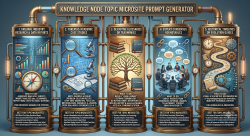
When completing the prompt generator, choose a descriptive content format that proves absolute authority. The goal is to be cited by others:
What to do: Aggregate raw data, survey results, or market analysis into a scannable report. Make the statistics easily quotable for journalists and AI engines. By providing the primary data, your microsite becomes the inevitable citation for anyone discussing those trends.
What to do: Write a rigorous account of a complex problem using a "problem-solution-result" format. Strip away marketing fluff. Focus on methodologies, variables, and lessons learned to prove real-world Experience (the first 'E' in E-E-A-T).
What to do: Build a "living library" that defines complex industry terminology. Go beyond simple definitions to include history, context, and technical nuance. This captures traffic from "what is [concept]" searches and acts as a standard citation.
What to do: Curate a collection of insights or technical opinions from recognized external leaders in the field. "Co-authored" content draws on the authority of the participants, encouraging them to share and backlink to your Hub.
What to do: Provide a visual and descriptive documentation of how a specific technology, regulation, or trend has evolved over time. Journalists and educators constantly look for objective historical context to cite in their own work.
This is an authoritative E-E-A-T asset. Do not use generic stock photos of "happy people reading." The visual must reflect the depth and objective nature of the knowledge being shared.
Ensure the header image features:
This diagnostic tool generates a highly engineered command designed specifically for Google's Gemini AI. Gemini provides superior accuracy when scanning live websites and generating the exact JSON-LD Schema and entity structures Google favours.
AI models prioritize information that demonstrates genuine, real-world application. For your Knowledge Node, ensure you include specific case studies, original data sets, or direct anecdotes from your operations rather than simply repeating generic industry theory.
Who is writing the content? A Knowledge Node must prove the author possesses the required skill or knowledge. Use Field 13 below to provide exact titles (e.g., "Dr. Jane Smith, Lead Prosthodontist"). The Webo engine will automatically wrap this in Person schema for algorithmic verification.
Authority is built through focused topical dominance and external validation. Your Node should focus strictly on one core topic without sales distractions. Ensure you use Field 8 to link an authoritative PDF, proving you have in-depth, structured documentation to back up your claims.
Trust is the most critical pillar. For AI engines, trust means factual accuracy, secure platforms, and clear citations. Use Field 9 to embed your tracked AI Citation Link. This allows LLMs to verify your entity source directly, completing the loop and driving safe, verified traffic to your domain.
Fill in your data below. When you click Generate, the Webo engine will build your exact prompt command and copy it to your clipboard.
Note: You can generate a prompt with partial or blank information (useful for testing). However, please be advised that the quality, accuracy, and detail of the final AI-generated output will directly reflect the extent and quality of the input you provide here.
Your AI instructions have been copied securely. To generate your microsite HTML, follow these 3 steps:


;)